

Risk Management · 2025
In this section2 topics
Risk Management Policy & Plan
Policy & Plan Description
Osotspa Public Company Limited recognizes that rapid changes in both the internal and external business environments may materially affect its business performance. To ensure effective and transparent operations, as well as the achievement of its established objectives, the Company places strong emphasis on risk management across all organizational levels. Accordingly, a comprehensive risk management framework has been established in alignment with the principles of Good Corporate Governance, with the objective of mitigating potential adverse impacts while enhancing business opportunities.
The Company’s risk management practices support the achievement of its corporate objectives and strategies, operational plans, and compliance with applicable laws and regulations, while delivering appropriate value to stakeholders. Risk management is conducted in accordance with internationally recognized standards under the COSO Enterprise Risk Management (COSO ERM) Framework, guided by the following key principles:
Identification, assessment, and documentation of enterprise risks, including the development of mitigation plans and continuous monitoring to ensure timely risk management within acceptable levels. Risk monitoring and reporting are conducted at least quarterly.
Establishment of clear risk assessment criteria based on the likelihood of occurrence and the potential impact of risks, both financial and non-financial.
Maintenance of an appropriate balance between risk and return to support the achievement of business objectives, meet stakeholder expectations, and create long-term shareholder value within acceptable risk levels.
Regular review of significant risks arising from changes in internal and external factors, such as product portfolio expansion and economic, political, or regulatory developments.
Annual review of the Risk Management Policy by the Risk Management Committee, with submission to the Board of Directors to ensure its continued relevance to the Company’s business context.
Risk Management Structure
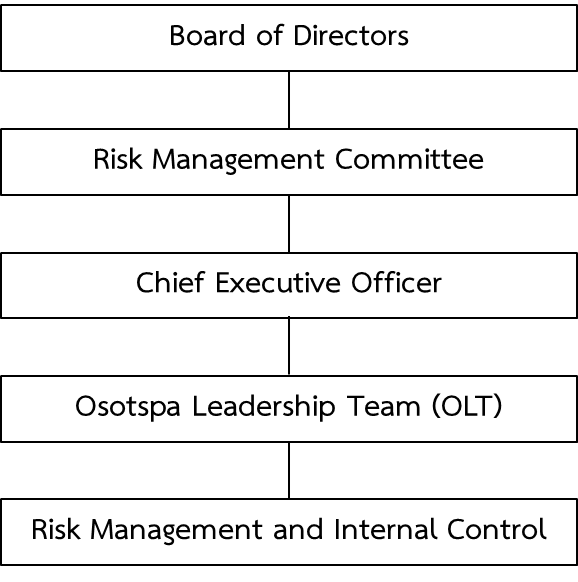
The Company has established a robust and clearly defined risk management governance framework, under which the Board of Directors serves as the highest governing body responsible for overseeing enterprise-wide risk management. To support the effective discharge of this responsibility, the Board has appointed a Risk Management Committee to provide guidance, supervision, and independent oversight of the enterprise risk management framework, ensuring alignment with the Company’s strategic objectives and the prevailing business environment.
The Osotspa Leadership Team (OLT) plays an integral role in driving the implementation of the risk management process and in continuously monitoring progress. In parallel, the Risk Management and Internal Control Working Team collaborates with relevant functions across the organization to identify and assess risks; develop and implement appropriate mitigation measures; monitor the effectiveness of risk management actions; and report risk management outcomes to executive management, the Risk Management Committee, and the Board of Directors on a quarterly basis. In addition, the Company shall hold joint meetings between the Risk Management Committee and the Audit Committee at least twice a year.
Enterprise Risk Management at Osotspa
The Company recognizes that comprehensive and effective risk management is a fundamental foundation for enhancing competitiveness and achieving long-term sustainable growth. Accordingly, risk management is implemented at two principal levels: Enterprise Risk Management (ERM) and Functional Risk Management (FRM). These approaches operate in an integrated and coordinated manner to manage risks across all levels of operations and to enhance the Company’s preparedness for future challenges. The Company’s risk assessment framework encompasses eight key risk categories: strategic risk, financial risk, operational risk, legal compliance and fraud risk, information technology risk, sustainability risk, reputation risk, and emerging risk.
In addition, the Company has implemented Business Continuity Management (BCM) as a key component of its overall risk management strategy, with a focus on strengthening preparedness for crisis events that may disrupt business operations. This includes the development of business recovery plans and effective response measures to ensure operational continuity in the event of unforeseen incidents. To further enhance organizational resilience, the Company has integrated ERM, FRM, and BCM into a unified and comprehensive risk management framework. The coordinated implementation of these three systems enables the Company to manage risks systematically, respond effectively to potential challenges and crises, and support sustainable business operations over the long term.
Building a Risk Management Culture
The Company places strong emphasis on fostering a robust and sustainable risk management culture throughout the organization. A formal Risk Management Policy has been established to ensure consistency and alignment in risk management practices across all risk categories, thereby supporting effective risk control and mitigation. In addition, the Company actively promotes awareness of risk management and internal controls among employees, with the objective of embedding risk-based thinking into day-to-day operations on a sustainable basis. Key initiatives include:
Leadership Role Modeling: Senior and middle management serve as role models in promoting risk-based management practices and are responsible for providing guidance to their teams. The Company organizes workshops for senior and middle management at least once a year to enhance awareness of emerging risks, business opportunities, and key challenges. These workshops facilitate the collective identification of risks, the development of appropriate mitigation measures, and the effective communication of identified risks and mitigation plans to relevant functions.
Integration into Management Processes: Risk and opportunity assessments are embedded within the O-IPM process, the Company’s internal management framework designed to support effective decision-making in delivering products and services to the market. This process also serves as the foundation of the Stage-Gate innovation management process, under which Gatekeepers are responsible for monitoring progress, assessing risks and opportunities, and determining whether projects should proceed, be deferred, or be discontinued.
Capability Building and Training: The Company provides risk management training to business units to enhance employees’ practical risk assessment capabilities. In 2025, training sessions and workshops were conducted for various business units, including the Manufacturing Function, with regular reporting to management to support continuous risk monitoring. In addition, the Company has established a long-term plan to progressively expand risk management training across all business units.
Ongoing Communication and Awareness: Risk management practices are communicated regularly throughout the organization. In 2025, the Company launched a Risk Management E-Learning Program for all employees and subsidiaries, with full participation required. The program achieved its targeted completion rate. Risk management and internal control topics are also communicated through OSP Live Talk sessions for management and employees at all levels, reinforcing awareness and promoting consistent understanding across the organization.
The Company remains committed to continuously strengthening its risk management and internal control culture, with senior and middle management serving as key role models in promoting sustainable, organization-wide risk management practices. The Company has clearly defined roles and responsibilities for risk management in accordance with the Three Lines Model of The Institute of Internal Auditors (IIA):
First Line
Senior executives of each business group, including the Osotspa Leadership Team (OLT), are responsible for implementing sustainability and risk management practices within their respective areas of accountability. Their responsibilities include communicating risks, plans, and mitigation measures; as well as controlling and monitoring performance to ensure alignment with established plans.
Second Line
The Risk Management and Internal Control Working Team is responsible for establishing risk management strategies, defining risk assessment criteria and acceptable risk levels, and developing risk monitoring and reporting processes. The team monitors implementation progress, provides guidance to business units, and communicates the Company’s risk management policy and framework across the organization. Progress updates and key performance outcomes are reported to the Risk Management Committee to support the ongoing review and enhancement of the Company’s risk management policy, governance structure, and overall risk management framework.
Third Line
The Internal Audit function and independent external auditors provide independent assurance by reviewing the Company’s internal controls and risk management processes, evaluating their effectiveness, and providing advisory services in accordance with internationally recognized standards. Audit results are reported directly to the Audit Committee to ensure independence and objectivity.
Risk Management Process and Examples of Key Risk Assessments
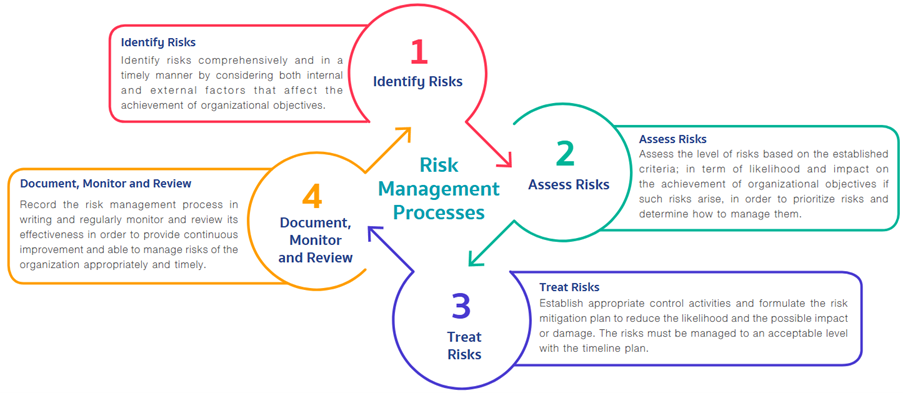
The Company has established a structured risk management process comprising the following key steps:
Identification of risks that may affect the Company’s business operations.
Assessment of the likelihood and potential impact of identified risks to prioritize and implement appropriate mitigation measures.
Implementation of appropriate risk mitigation actions.
Continuous monitoring and reporting of risk management outcomes to the Risk Management Committee and the Board of Directors, along with regular communication to relevant functions across the organization.
In addition, the Company has established Risk Assessment Criteria to evaluate and review key risks based on their likelihood of occurrence and potential impact on the business and its stakeholders. Impact assessments cover financial performance, reputation and brand image, operations, supply chain, legal and regulatory compliance, human resources, safety, occupational health, and the work environment. Risk impacts are classified into four levels, as defined in the Company’s Risk Management Policy.
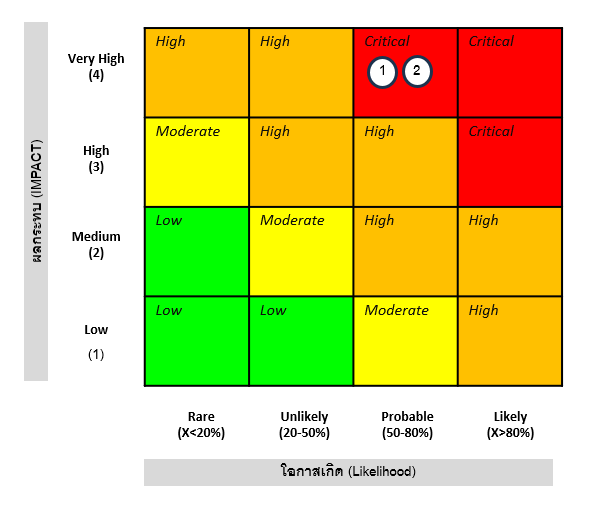
Examples of Critical risks
Risk No.1: Overseas Operations Risk in Myanmar – Political, Foreign Exchange, and Natural Disasters
The Company’s business operations in Myanmar are exposed to a range of risk factors, including political instability, foreign exchange controls and currency volatility, economic and social challenges, as well as the increasing frequency and severity of natural disasters. These factors may adversely affect operational continuity, financial stability, and the Company’s ability to sustainably operate and expand its business in the Myanmar market.
Risk Impact
Supply chain disruptions arising from political unrest, instability, or policy changes may delay procurement and distribution activities, resulting in product shortages, operational disruptions, and increased costs.
Natural disasters may temporarily suspend or disrupt business operations, including interruptions to public utilities and product distribution in affected areas.
Declining purchasing power in Myanmar may adversely impact the Company’s sales performance.
Mitigation Plan
The Company places significant importance on this matter, as Myanmar represents one of its key international markets with a substantial customer base. Accordingly, the Company has implemented the following measures:
Closely monitor the situation and maintain appropriate contingency plans, with regular reporting to management and relevant committees to enable timely and prudent responses.
Diversify markets and customer segments, with a focus on customers with strong financial standing, to mitigate potential impacts from a market slowdown in Myanmar.
Adjust operational strategies and processes, as appropriate, to align with local conditions and effectively manage political and other uncertainties.
Risk No.2: Business Competition and Market Share Risk
Risks arising from intensified competition from both existing and new market players—including competition in pricing, innovation, product quality, distribution channels, and marketing activities—may adversely affect the Company’s competitiveness and market share.
Risk Impact
Potential declines in the Company’s revenue, profitability, and market share.
Higher costs resulting from intensified competition.
Increased challenges in sustaining market leadership and brand loyalty.
Mitigation Plan
In a highly competitive market environment within the beverage and personal care industries, risks related to business competition and market share are of significant importance. The Company has implemented the following measures to effectively manage these risks:
Develop and continuously refine marketing strategies by analyzing cost structures, market trends, and competitor movements; overseeing distribution channels and partnerships; and assessing both the existing customer base and anticipated changes in demand.
Design and implement ongoing marketing and promotional initiatives tailored to specific customer segments, with continuous evaluation of results to identify improvement opportunities and enhance overall effectiveness.
Develop new products and innovations to expand offerings, increase brand awareness, strengthen brand equity, and maintain customer engagement.
Continuously monitor, assess, and refine strategies to improve operational efficiency and drive overall business performance.
Policy Document Link
https://sustainability.osotspa.com/storage/document/policy-and-guidelines/risk-management-policy-en.pdf
Risks to the Company's Business Operations
Risk Register
| Risk Name | Risk Characteristics | Consequences | Management Measures | Related Risk Factors |
|---|---|---|---|---|
| Strategic and Financial Risks: Risks associated with new investments and business operations, both domestically and internationally, arising from economic uncertainty, foreign exchange volatility, and natural disasters or unforeseen events that may disrupt business operations. |
|
| The Company has established a comprehensive approach to investment expansion and partner evaluation to access new customer segments and markets, enhance business capabilities, and effectively manage risks related to financial performance and business continuity. The implementation measures are as follows: Domestic and International Investments
Overseas Business Operations
Foreign Exchange Volatility
Business Disruption from Unforeseen Events
| 756 · Description: Change in laws and regulations · Info category: COMPLIANCE_RISK · 728 · Description: Volatility in the industry in which the company operates · Info category: STRATEGIC_RISK · 757 · Description: Laws and regulations is not favorable for doing business · Info category: COMPLIANCE_RISK · 729 · Description: Behavior or needs of customers / consumers · Info category: STRATEGIC_RISK · 730 · Description: Government policy · Info category: STRATEGIC_RISK · 740 · Description: Shortage or fluctuation in pricing of raw materials or productive resources · Info category: OPERATIONAL_RISK · 758 · Description: Violations of laws and regulations · Info category: COMPLIANCE_RISK · 731 · Description: Policies or international agreements related to business operations · Info category: STRATEGIC_RISK · 764 · Description: Fluctuation in exchange rates, interest rates, or the inflation rate · Info category: FINANCIAL_RISK · 765 · Description: Fluctuation in return on assets or investment · Info category: FINANCIAL_RISK · 1723 · Description: Legal risk · Info category: COMPLIANCE_RISK · 733 · Description: Business operations of partners in the supply chain · Info category: STRATEGIC_RISK · 1725 · Description: Income volatility · Info category: FINANCIAL_RISK · 745 · Description: Loss or damage from non-compliance of partners or counterparties · Info category: OPERATIONAL_RISK · 746 · Description: Delays in the development of future projects · Info category: OPERATIONAL_RISK · 736 · Description: Damage to company image and reputation · Info category: STRATEGIC_RISK · 1715 · Description: Economic risk · Info category: STRATEGIC_RISK · 1716 · Description: New business risk · Info category: STRATEGIC_RISK |
| Business Competition and Market Share Risk | Risks arising from intensified competition from both existing and new competitors—including competition in pricing, innovation, product quality, distribution channels, and marketing activities—may adversely affect the Company’s competitiveness and market share. |
| In a highly competitive market environment within the beverage and personal care industries, risks related to business competition and market share are of significant importance. The Company has implemented the following measures to effectively manage these risks:
| 728 · Description: Volatility in the industry in which the company operates · Info category: STRATEGIC_RISK · 729 · Description: Behavior or needs of customers / consumers · Info category: STRATEGIC_RISK · 757 · Description: Laws and regulations is not favorable for doing business · Info category: COMPLIANCE_RISK · 740 · Description: Shortage or fluctuation in pricing of raw materials or productive resources · Info category: OPERATIONAL_RISK · 730 · Description: Government policy · Info category: STRATEGIC_RISK · 731 · Description: Policies or international agreements related to business operations · Info category: STRATEGIC_RISK · 732 · Description: Changes in technologies · Info category: STRATEGIC_RISK · 733 · Description: Business operations of partners in the supply chain · Info category: STRATEGIC_RISK · 734 · Description: Reliance on large customers or few customers · Info category: STRATEGIC_RISK · 735 · Description: Reliance on large partners / distributors or few partners / distributors · Info category: STRATEGIC_RISK · 745 · Description: Loss or damage from non-compliance of partners or counterparties · Info category: OPERATIONAL_RISK · 736 · Description: Damage to company image and reputation · Info category: STRATEGIC_RISK · 1714 · Description: Competition risk · Info category: STRATEGIC_RISK · 1715 · Description: Economic risk · Info category: STRATEGIC_RISK · 1721 · Description: Inventory risk · Info category: OPERATIONAL_RISK |
| Commodity Price Volatility Risk | Fluctuations in the prices of raw materials and commodities such as sugar, glass scrap, natural gas, and other key production inputs driven by global supply and demand dynamics, government policies and regulations, import restrictions, tariffs and customs duties, and overall economic conditions. |
| Fluctuations in product, raw material, and packaging prices may significantly affect the Company’s cost structure. To mitigate such risks, the Company has implemented the following measures:
| 728 · Description: Volatility in the industry in which the company operates · Info category: STRATEGIC_RISK · 733 · Description: Business operations of partners in the supply chain · Info category: STRATEGIC_RISK · 734 · Description: Reliance on large customers or few customers · Info category: STRATEGIC_RISK · 735 · Description: Reliance on large partners / distributors or few partners / distributors · Info category: STRATEGIC_RISK · 745 · Description: Loss or damage from non-compliance of partners or counterparties · Info category: OPERATIONAL_RISK · 1715 · Description: Economic risk · Info category: STRATEGIC_RISK · 1721 · Description: Inventory risk · Info category: OPERATIONAL_RISK |
| Product Quality and Food Safety Risk | Contamination of raw materials or finished products, or the entry of unsafe counterfeit products into the market. |
| The Company prioritizes product quality and safety, given its operations in the consumer goods industry. Accordingly, stringent quality control measures are implemented throughout the production and distribution processes. The Company has established the following management approaches:
| 756 · Description: Change in laws and regulations · Info category: COMPLIANCE_RISK · 729 · Description: Behavior or needs of customers / consumers · Info category: STRATEGIC_RISK · 758 · Description: Violations of laws and regulations · Info category: COMPLIANCE_RISK · 1723 · Description: Legal risk · Info category: COMPLIANCE_RISK · 736 · Description: Damage to company image and reputation · Info category: STRATEGIC_RISK · 1717 · Description: ESG risk · Info category: STRATEGIC_RISK · 751 · Description: Impact on the environment · Info category: OPERATIONAL_RISK · 755 · Other name: Quality and Safety of Product · Description: Other · Info category: OPERATIONAL_RISK |
| Workforce Capability and Succession Risk Impacting Business Growth | Human capital is a critical factor in the Company’s business operations. Reliance on key personnel, shortages of skilled talent, limited employee capabilities, and a lack of organizational agility may pose challenges to business success. These risks are particularly significant in relation to workforce capability development, which is essential for enhancing organizational competitiveness and driving the establishment of a high-performance culture. |
| Human resource management is critical to sustainable success. Reliance on key personnel and skill gaps may present risks to organizational growth. The Company therefore prioritizes capability development and the promotion of a high performance culture to address future challenges through the following initiatives:
| 738 · Description: Reliance on employees in key positions · Info category: OPERATIONAL_RISK · 739 · Description: Shortage or reliance on skilled workers · Info category: OPERATIONAL_RISK · 742 · Description: Human error in business operations · Info category: OPERATIONAL_RISK · 736 · Description: Damage to company image and reputation · Info category: STRATEGIC_RISK · 767 · Other name: Revenue may not be achieved in line with targets · Description: Other · Info category: FINANCIAL_RISK |
| Compliance with applicable laws, regulations, and regulatory requirements, including any changes thereto. | Non-compliance with applicable legal and regulatory requirements may result in legal proceedings, penalties, fines, or reputational damage to the Company. In addition, changes in laws or tax regulations may materially affect the Company’s financial position and financial reporting. |
| The Company strictly complies with applicable laws and regulations to mitigate both financial and non-financial risks. Key measures include:
| 756 · Description: Change in laws and regulations · Info category: COMPLIANCE_RISK · 757 · Description: Laws and regulations is not favorable for doing business · Info category: COMPLIANCE_RISK · 758 · Description: Violations of laws and regulations · Info category: COMPLIANCE_RISK · 731 · Description: Policies or international agreements related to business operations · Info category: STRATEGIC_RISK · 759 · Description: Corporate Governance · Info category: COMPLIANCE_RISK · 732 · Description: Changes in technologies · Info category: STRATEGIC_RISK · 1723 · Description: Legal risk · Info category: COMPLIANCE_RISK · 754 · Description: Corruption · Info category: OPERATIONAL_RISK · 1721 · Description: Inventory risk · Info category: OPERATIONAL_RISK |
| Cybersecurity and Data Leakage Risk | Cybersecurity threats and breaches of digital assets may result in the exposure of sensitive information, including legally protected personal data. Such incidents can lead to significant reputational damage, regulatory non-compliance, and financial losses. |
| The Company recognizes the importance of cybersecurity and information security risk management and has implemented the following measures:
| 758 · Description: Violations of laws and regulations · Info category: COMPLIANCE_RISK · 731 · Description: Policies or international agreements related to business operations · Info category: STRATEGIC_RISK · 759 · Description: Corporate Governance · Info category: COMPLIANCE_RISK · 1723 · Description: Legal risk · Info category: COMPLIANCE_RISK · 744 · Description: Information security and cyber-attack · Info category: OPERATIONAL_RISK · 1720 · Description: System disruption risk · Info category: OPERATIONAL_RISK · 755 · Other name: The risk related to the security and protection of personal data of business stakeholders. · Description: Other · Info category: OPERATIONAL_RISK |
| Sustainability Risk | The Company conducts sustainability risk assessments by comprehensively evaluating risk factors that may affect the Company across legal, operational, social, and environmental dimensions, including the following:
Note: Additional ESG risk information EN: https://sustainability.osotspa.com/en/ensuring-mutual-growth/enterprise-risk-management |
| Sustainability risk management is a critical priority for the Company, as it may have wide-ranging impacts on the environment, communities, the economy, and society, all of which can affect business operations across multiple dimensions. Accordingly, the Company has established the following approaches and mitigation plans:
| 756 · Description: Change in laws and regulations · Info category: COMPLIANCE_RISK · 757 · Description: Laws and regulations is not favorable for doing business · Info category: COMPLIANCE_RISK · 730 · Description: Government policy · Info category: STRATEGIC_RISK · 758 · Description: Violations of laws and regulations · Info category: COMPLIANCE_RISK · 731 · Description: Policies or international agreements related to business operations · Info category: STRATEGIC_RISK · 759 · Description: Corporate Governance · Info category: COMPLIANCE_RISK · 732 · Description: Changes in technologies · Info category: STRATEGIC_RISK · 1723 · Description: Legal risk · Info category: COMPLIANCE_RISK · 760 · Other name: Community and environmental safety · Description: Other · Info category: COMPLIANCE_RISK · 736 · Description: Damage to company image and reputation · Info category: STRATEGIC_RISK · 767 · Other name: Higher operating costs resulting from compliance with new regulatory requirements · Description: Other · Info category: FINANCIAL_RISK · 749 · Description: Safety, occupational health, and working environment · Info category: OPERATIONAL_RISK · 750 · Description: Climate change and disasters · Info category: OPERATIONAL_RISK · 1717 · Description: ESG risk · Info category: STRATEGIC_RISK · 751 · Description: Impact on the environment · Info category: OPERATIONAL_RISK · 1718 · Description: Pandemic risk · Info category: STRATEGIC_RISK · 1719 · Description: Climate change and disasters · Info category: STRATEGIC_RISK · 753 · Description: Impact on human rights · Info category: OPERATIONAL_RISK |
| Emerging Risk | The Company assesses emerging risks by identifying potential long-term issues whose impacts are not yet fully apparent, have not yet materialized, or have not been previously addressed. The key emerging risks are as follows:
|
|
| 728 · Description: Volatility in the industry in which the company operates · Info category: STRATEGIC_RISK · 756 · Description: Change in laws and regulations · Info category: COMPLIANCE_RISK · 729 · Description: Behavior or needs of customers / consumers · Info category: STRATEGIC_RISK · 757 · Description: Laws and regulations is not favorable for doing business · Info category: COMPLIANCE_RISK · 730 · Description: Government policy · Info category: STRATEGIC_RISK · 758 · Description: Violations of laws and regulations · Info category: COMPLIANCE_RISK · 731 · Description: Policies or international agreements related to business operations · Info category: STRATEGIC_RISK · 732 · Description: Changes in technologies · Info category: STRATEGIC_RISK · 733 · Description: Business operations of partners in the supply chain · Info category: STRATEGIC_RISK · 1725 · Description: Income volatility · Info category: FINANCIAL_RISK · 736 · Description: Damage to company image and reputation · Info category: STRATEGIC_RISK · 746 · Description: Delays in the development of future projects · Info category: OPERATIONAL_RISK · 1715 · Description: Economic risk · Info category: STRATEGIC_RISK · 750 · Description: Climate change and disasters · Info category: OPERATIONAL_RISK · 1717 · Description: ESG risk · Info category: STRATEGIC_RISK · 751 · Description: Impact on the environment · Info category: OPERATIONAL_RISK · 1719 · Description: Climate change and disasters · Info category: STRATEGIC_RISK · 737 · Other name: Raw Material Price Volatility · Description: Other · Info category: STRATEGIC_RISK |